

A date calculator should not be a black box. This page documents the exact counting model used by SchengenStay.EU, the assumptions behind it, the test cases we use to catch mistakes, and the situations it deliberately does not decide.
The rule we implement
For a typical visa-exempt short stay, a traveller may be present in the Schengen Area for no more than 90 days in any 180-day period. The official European Commission guidance says to count backwards 180 days from each day of the stay. Entry and exit are both days of presence. This means there is no single six-month block and no universal reset date.
In compact form, a proposed day is compliant when:
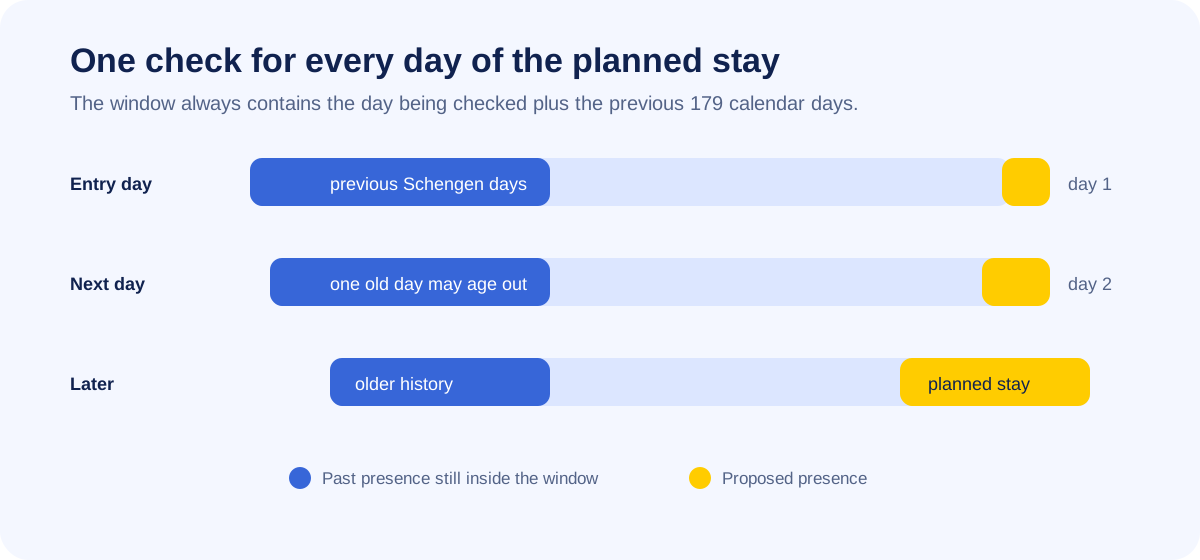
Calculation process, step by step
Normalise the dates
We read each date as a calendar day at 00:00 UTC. A stay written backwards is normalised into chronological order. Incomplete date pairs are not counted.
Merge overlapping history
If two past trips overlap or touch, they are treated as one continuous presence period. The same calendar date can therefore never be counted twice.
Build the presence record
Every date from entry through exit is placed into a set of used Schengen days. Both endpoints are included. A trip from 1 to 3 May therefore uses three days, not two.
Check the proposed entry
For the entry date, we inspect the window beginning 179 days earlier and ending on entry. If 90 historical days remain in that interval, no new day is available.
Walk forward one day at a time
For each possible day of the proposed stay, the tool shifts the window forward and counts historical plus proposed presence again. It stops before the first day that would take the total above 90.
Report the last compliant exit
The maximum stay is the number of consecutive proposed days that passed the daily check. The final included date is reported as the maximum exit date.
Public verification cases
These cases are intentionally different: a clean record, split history, a full allowance, and a stay where old days expire while the traveller remains in Schengen. They are recalculated whenever the counting code changes.
| Input | Entry | Expected result | What it tests |
|---|---|---|---|
| No past trips | 1 Apr 2026 | 90 days, through 29 Jun | Inclusive entry and exit |
| 10–19 Jan and 5–19 Mar | 1 Jun 2026 | 25 used; 75 days, through 14 Aug | Split-trip aggregation |
| 1 Mar–29 May | 1 Jul 2026 | 0 days available | Full 90-day history |
| 1 Mar–29 May | 28 Aug 2026 | 89 used; up to 90 new days | Old days aging out during a stay |
| 1–30 Apr, 1–30 Jun, 1–25 Aug | 1 Sep 2026 | 85 used; 5 days, through 5 Sep | Three disjoint periods |
For the full workings and calculator links, see our 90/180 case-study library.
What the calculator does not decide
The arithmetic is only one part of lawful travel. The tool cannot determine whether you need a visa, whether a bilateral agreement applies, whether a residence permit changes the count, whether your intended activity is permitted, or whether a border authority will admit you. It also does not interpret missing stamps or resolve a disagreement with an EES record.
- If a short-stay visa authorises fewer than 90 days, the visa's limit controls.
- Days covered by a long-stay visa or residence permit require document-specific treatment.
- Cyprus and Ireland are not part of the shared Schengen short-stay area; their national rules must be checked separately.
- Only the competent border, immigration or consular authority can make a binding decision about an individual case.
How we check and correct results
We compare the method and material examples with the European Commission's short-stay guidance, test boundary dates where the 90th or 180th day changes the outcome, and scan for duplicate statements in page text and metadata when a rule changes. Reports sent through our contact page are checked against primary sources. A confirmed problem is corrected across the calculator, examples and related guides, and the visible review date is updated.
Independent verification: if a journey matters for a visa application, employment, family visit or past overstay, enter the same dates in the European Commission calculator and consult the authority responsible for the destination. A matching result reduces arithmetic risk; it does not guarantee admission.